 NorCloud login


/Nor150-sound-inensity-jorge(800x800px).webp?width=800&height=800&name=Nor150-sound-inensity-jorge(800x800px).webp)
.webp?width=1824&height=2736&name=Norsonic_v2-74-(1824x2736px).webp)
/Nor286-Origami/Nor286-origami-light-blue-800x600px.webp?width=450&height=275&name=Nor286-origami-light-blue-800x600px.webp)
How reusable is an Origami Impulse Source for reverberation time measurements?

/Impedance%20tube%20white%20webp%20(664x664px)/Nor1527-3-white-(664x664px).webp?width=664&height=664&name=Nor1527-3-white-(664x664px).webp)
/Impedance%20tube%20white%20webp%20(664x664px)/Nor1527-5-white-(664x664px).webp?width=664&height=664&name=Nor1527-5-white-(664x664px).webp)
/Impedance%20tube%20white%20webp%20(664x664px)/Nor1527-1-white-(664x664px).webp?width=664&height=664&name=Nor1527-1-white-(664x664px).webp)
/Impedance%20tube%20white%20webp%20(664x664px)/Nor1527-6-white-(664x664px).webp?width=664&height=664&name=Nor1527-6-white-(664x664px).webp)
/Impedance%20tube%20white%20webp%20(664x664px)/Nor1527-2-white-(664x664px).webp?width=664&height=664&name=Nor1527-2-white-(664x664px).webp)
/Impedance%20tube%20white%20webp%20(664x664px)/Nor1527-13-white-(664x664px).webp?width=664&height=664&name=Nor1527-13-white-(664x664px).webp)
/Impedance%20tube%20white%20webp%20(664x664px)/Nor1527-11-white-(664x664px).webp?width=664&height=664&name=Nor1527-11-white-(664x664px).webp)
The sound absorption coefficient of acoustic materials can be determined in accordance with the standard ISO 10534-2, “Acoustics – Determination of acoustic properties in impedance tubes – Part 2: Transfer-function method using two microphones for sound absorption coefficient and surface impedance under normal incidence.” Depending on the diameter of the tube used, measurements can be carried out in the ranges of 50–1600 Hz or 200–6400 Hz. The measurements are performed by generating a stochastic acoustic excitation (noise) with the sound source and capturing the sound components reflected by the material.
In a four-microphone configuration, the transmission loss of acoustic materials can be measured in accordance with the standard ASTM E2611, “Measurement of Normal Incidence Sound Transmission of Acoustical Materials Based on the Transfer Matrix.” Depending on the tube configuration used, measurements can be carried out in the ranges of 50–1600 Hz or 200–6400 Hz. The measurement is performed by generating a stochastic acoustic excitation (noise) with the sound source and capturing both the reflected and transmitted sound energy at the material.

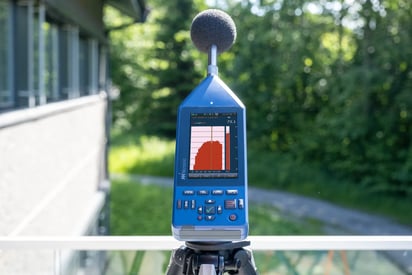
Reliable noise monitoring with sound level meter, stand-alone terminals or large-scale systems.
.webp?width=1824&height=2736&name=Image-107-(1824x2736px).webp)
Building acoustic is about the sound that travels between rooms - something you'd rather avoid.


.webp?width=450&height=275&name=NoiseTag-in-NorCloud-round-corners(1200x850px).webp)