 NorCloud login


How does sound behave in a room?
Assume that we place a sound level meter at a fixed position in a room and then start a sound source. This source could be a machine, or a combination of a noise generator, power amplifier, and loudspeaker.
At first, one might expect the sound pressure level in the room to keep increasing as long as the sound source continues to emit energy. In reality, this does not happen. Instead, the sound level rises and then stabilizes at a certain value.
Why does the sound level stabilize instead of increasing indefinitely?
The reason is that the sound energy entering the room is balanced by the sound energy leaving the system.
Sound energy is removed from the room in two main ways:
-
Absorption by the room boundaries, such as walls, ceiling, floor, furniture, and other materials
-
Transmission through the boundaries, where sound passes through walls, doors, windows, or ceilings into adjacent rooms or to the outside
When the rate of incoming sound energy equals the rate of absorbed and transmitted energy, the sound pressure level reaches a steady state.
How can sound absorption in a room be increased?
The amount of sound absorption can be increased by introducing materials that dissipate sound energy, such as:
-
Carpets
-
Curtains
-
Soft furniture
-
Acoustic panels
These materials reduce reflections and lower the overall sound level in the room.
How does sound transmission affect the sound level in a room?
Sound transmission occurs when acoustic energy passes through the room boundaries.
A very effective way of increasing sound transmission is simply opening a window. In this case, a significant amount of sound energy escapes the room, which leads to a noticeable reduction of the sound level inside.
This principle is particularly important in building acoustics, where the main concern is often noise coming from adjacent rooms or from outside the building.
What is sound insulation in building acoustics?
Sound insulation describes the ability of a building element—such as a wall, floor, or ceiling—to reduce sound transmission from one space to another.
In building acoustics, insulation values must be objective and normalized, meaning they should not depend on the current conditions of the receiving room, such as furniture or temporary absorption. The goal is to characterize the insulating performance of the building element itself.
This approach is essential because building regulations in many countries specify minimum sound insulation requirements.
What are the source room and the receiving room?
When performing sound insulation measurements, two spaces are defined:
-
The source room, where the sound is generated and measured
-
The receiving room, where the transmitted sound is measured
The measured level difference between these two rooms must be corrected in order to compensate for the influence of the receiving room’s reverberation and background noise.
Why is reverberation time relevant in building acoustics?
Reverberation time directly affects the sound pressure level measured in receiving rooms. For this reason, airborne and impact sound insulation results are normalized using the reverberation time of the receiving space. Without this correction, measurement results would depend on the acoustic condition of the room rather than on the intrinsic performance of the building element.
Why is background noise relevant in building acoustics?
Background noise directly affects the sound pressure levels measured during building acoustics tests. For this reason, background noise is evaluated and, when necessary, corrections are applied according to the relevant standards. Without this consideration, measurement results may be influenced by internal or external noise sources rather than by the intrinsic performance of the building element.
What types of sound insulation are considered in buildings?
In building acoustics, sound insulation is classified according to how sound is transmitted. In practice, three main types are considered:
-
Airborne sound insulation, related to sound travelling through the air between rooms
-
Impact sound insulation, related to structure-borne vibrations caused by mechanical excitation, such as footsteps on floors
-
Façade sound insulation, related to sound transmitted from outdoor sources into a building through façades, windows, and other external elements
Depending on the building structure and the noise sources involved, one or more of these types must be evaluated.
Why are impact sound insulation measurements sometimes required?
Many modern buildings have homogeneous and rigid structures, such as solid concrete constructions, with low internal damping. In these cases, sound energy can propagate efficiently through the structure with relatively little attenuation.
As a result, impact sound insulation measurements—for example, noise generated by footsteps on floors—are often required in addition to airborne sound insulation measurements.
How is airborne sound insulation measured between two rooms?
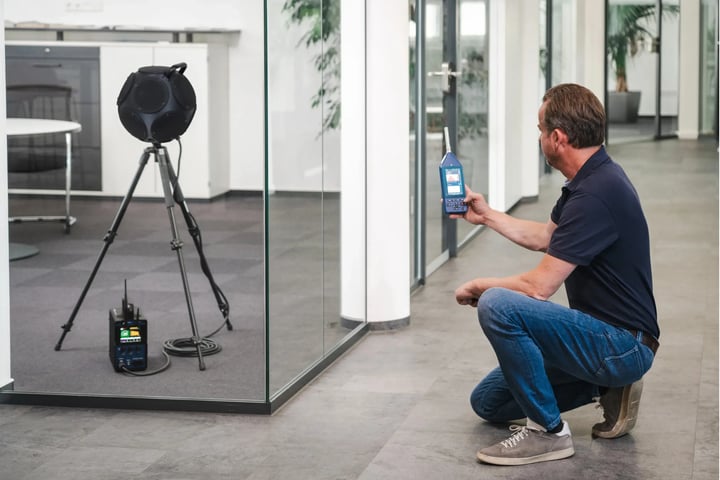
Airborne sound insulation is measured between two spaces: a source room, where sound is generated, and a receiving room, where the transmitted sound is evaluated.
In the source room, a loudspeaker is used to generate a broadband test signal, usually pink noise. Sound pressure levels are measured at several positions and spatially averaged to obtain a representative level for the room. The loudspeaker is placed in more than one position to ensure that the sound field in the source room is adequately excited.
In the receiving room, sound pressure levels are also measured at multiple positions and spatially averaged, since the sound field is not uniform. The background noise level is measured with the source switched off and taken into account if it affects the result.
Finally, the reverberation time of the receiving room is measured and used to correct the receiving sound level. This ensures that the resulting sound insulation value reflects the performance of the separating element rather than the acoustic condition of the rooms.
Why is pink noise used instead of white noise?

The excitation signal used in building acoustics measurements is typically pink noise, measured in octave or third-octave bands.
To understand why pink noise is preferred, it is important to consider how octave bands are defined. Each octave band covers a wider frequency range than the one below it. As frequency doubles, the bandwidth of the octave also doubles, meaning that higher-frequency octaves include a much larger number of individual frequencies.
White noise has a constant spectral density, which means it contains the same amount of energy per hertz at all frequencies. Because higher octaves are wider, white noise would contain significantly more total energy in the higher-frequency bands. This would cause the high-frequency octaves to dominate the measurement results.
Pink noise is designed to compensate for this effect. Its sound level decreases by −3 dB per octave as frequency increases. A reduction of −3 dB corresponds to halving the energy. This reduction exactly balances the doubling of the octave bandwidth, resulting in the same total acoustic energy in each octave band.
As a result, pink noise excites all octave and third-octave bands uniformly, making it well suited for building acoustics measurements and more representative of real-world sound fields commonly found in buildings.
What happens if the receiving room level is too low?
|
In some cases, the sound insulation of a wall is so high that the measured sound pressure level in the receiving room is masked by the background noise. If increasing the source level is not practical due to loudspeaker limitations, an alternative solution is to excite the source room with band-limited noise instead of broadband noise. By concentrating the available output power into a single frequency band, the measurement level can be increased by 10–15 dB, which is often sufficient to obtain valid results. This approach requires instrumentation capable of performing serial frequency analysis, a feature commonly available in professional building acoustics measurement systems. |
/Noise%20sources%20transparent%20webp%20(664x664px)/Nor282-limited-band.webp?width=800&height=600&name=Nor282-limited-band.webp) |
How is sound insulation finally calculated?
In practice, sound insulation is not calculated as a single number from the start. The measurement is first carried out by frequency, usually in octave or third-octave bands. This is important because walls and floors do not block all frequencies in the same way: low frequencies and high frequencies behave very differently.
For each frequency band, the sound pressure level measured in the receiving room is first corrected for background noise, when the background noise is high enough to affect the result. After that, a correction for the reverberation time of the receiving room is applied, so that the result does not depend on how furnished or absorbent the room is.
Once these corrections are made, the corrected receiving room level is compared with the corresponding level measured in the source room. This gives a frequency-dependent sound insulation curve, showing how much sound is reduced at each frequency.
To make the result easier to use in practice, this frequency-dependent curve is usually converted into a single sound insulation value. This is done by fitting the measured curve to a standard reference curve, following the method defined in the applicable standards.
The resulting single-number value provides a practical description of the insulating performance of the building element and allows different constructions to be compared in a consistent way.
Standards and further learning
ISO 16283 describes the requirements and guidelines for the use of modern measurement methods in building acoustics.
To explore these topics further—including reverberation, impact noise, and practical measurement techniques—we invite you to continue learning through our technical resources at Norsonic
/Nor286-Origami/Nor286-origami-light-blue-800x600px.webp?width=450&height=275&name=Nor286-origami-light-blue-800x600px.webp)
/Nor850%20Software%20transparent%20webp%20(664x664px)/Nor850-RA-ISO3382.webp?width=450&height=275&name=Nor850-RA-ISO3382.webp)


