 NorCloud login


/Noise%20sources%20transparent%20webp%20(664x664px)/Nor277-Tapping-machine-transparent-(664x664px).webp?width=720&name=Nor277-Tapping-machine-transparent-(664x664px).webp)
What is impact sound insulation?
Impact sound insulation describes the ability of a floor or building structure to reduce the transmission of structure-borne sound generated by mechanical excitation.
Typical examples include footsteps, objects dropped onto the floor, furniture being moved, or other impacts that introduce vibration directly into the building structure.
Unlike airborne sound insulation, where sound travels through the air before reaching a separating element, impact sound originates within the structure itself and propagates through floors, walls, and other connected building elements.
For this reason, impact sound insulation is an important parameter when evaluating acoustic comfort in residential, commercial, and public buildings.
How does impact sound propagate through a building?
When an object strikes a floor, part of the impact energy is converted into structural vibration.
These vibrations travel through the floor and adjacent building elements before being radiated as airborne sound in neighboring spaces. Depending on the construction type, impact sound can propagate over considerable distances within the building structure.
Modern buildings often use homogeneous and rigid materials such as concrete, which can efficiently transmit vibration. As a result, impact noise generated in one area may be clearly audible in adjacent or lower rooms.
Understanding how vibration propagates through a structure is essential for evaluating and improving impact sound insulation performance.
Why is impact sound insulation important?
Impact sound insulation directly affects occupant comfort.
Even when airborne sound insulation between rooms is good, inadequate impact sound insulation can lead to complaints caused by footsteps, furniture movement, or other activities occurring in neighboring spaces.
For this reason, many building regulations specify minimum impact sound insulation requirements for residential and commercial buildings.
How is impact sound insulation measured?
Impact sound insulation is typically measured using a standardized tapping machine placed on the floor under test.
The tapping machine generates a series of controlled impacts that simulate a repeatable mechanical excitation of the structure.
This standardized source ensures that measurements can be compared between different buildings and construction systems.
The sound pressure level generated by these impacts is measured in the receiving room below or adjacent to the floor being tested.
Measurements are performed using multiple microphone positions in the receiving room and multiple tapping machine positions on the floor under test in order to obtain representative average results.
What is a tapping machine?A tapping machine such as the Nor277 is a standardized impact source used for impact sound insulation measurements. The device contains a set of hammers that repeatedly strike the floor surface at a controlled rate and force. Because the excitation is standardized, measurements performed in different buildings and by different operators remain comparable. The tapping machine is specified in international standards and is widely used for both laboratory and field measurements of impact sound insulation. |
/Noise%20sources%20transparent%20webp%20(664x664px)/Nor277-Tapping-machine-transparent-(664x664px).webp?width=664&height=664&name=Nor277-Tapping-machine-transparent-(664x664px).webp) |
Why is reverberation time relevant in impact sound insulation measurements?
Reverberation time directly affects the sound pressure level measured in receiving rooms. For this reason, impact sound insulation results are normalized using the reverberation time of the receiving space.
Without this correction, measurement results would depend on the acoustic condition of the room rather than on the intrinsic performance of the floor construction.
Why is background noise relevant in impact sound insulation measurements?
Background noise directly affects the sound pressure levels measured in receiving rooms. For this reason, it is assessed as part of the measurement procedure.
Without considering background noise, the measured levels may not accurately represent the sound generated by the impact source and transmitted through the building structure.
Why are measurements performed by frequency band?
Impact sound insulation performance varies significantly with frequency.
Some floor constructions may provide good insulation at high frequencies while allowing low-frequency vibrations to be transmitted more easily. For this reason, measurements are performed in octave or third-octave frequency bands.
Evaluating the frequency-dependent behavior of the floor provides a more complete understanding of its acoustic performance.
How is impact sound insulation calculated?
Impact sound insulation measurements are initially evaluated by frequency band.
For each frequency band, the measured sound pressure levels are corrected for background noise when necessary and normalized using the reverberation time of the receiving room.
The resulting spectrum represents the impact sound transmitted through the floor construction.
To simplify interpretation and comparison, the measured spectrum is converted into a single-number rating according to ISO 717-2. This value provides a practical indication of the impact sound insulation performance of the floor.
Why does a lower impact sound level indicate better insulation?
At first glance, impact sound insulation results may seem counterintuitive. In airborne sound insulation measurements, higher values indicate better performance because the result is based on the difference between the sound levels measured in the source room and the receiving room.
Impact sound insulation measurements follow a different principle. The standardized tapping machine excites the floor structure directly, and the quantity being evaluated is the sound pressure level generated in the receiving room by that excitation.
Because the impact source introduces a known and repeatable amount of energy into the structure, there is no need to measure a corresponding sound level in the source room. The airborne sound present in the source room is simply a by-product of the impacts and is not representative of the vibration energy transmitted through the structure.
As a result, impact sound insulation is assessed from the sound level measured in the receiving room. A lower measured level means that less vibration energy is being transmitted through the floor and converted into airborne sound, indicating better impact sound insulation performance.
For this reason, impact sound insulation ratings such as normalized impact sound pressure level are interpreted in the opposite way to airborne sound insulation ratings: lower values correspond to better acoustic performance.
Typical applications of impact sound insulation measurements
Impact sound insulation measurements are commonly performed in:
-
residential buildings,
-
apartment complexes,
-
hotels,
-
offices,
-
schools and universities,
-
hospitals and healthcare facilities.
These measurements help verify compliance with building regulations and assess the acoustic quality of occupied spaces.
Impact Sound Insulation Measurements with Nor145 and Nor850
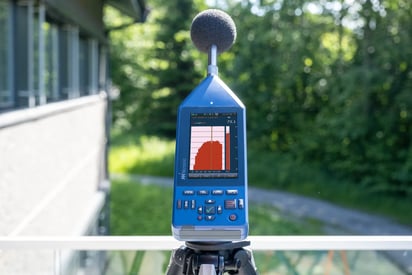
Nor145 and Nor850 provide tools for performing and analyzing impact sound insulation measurements in accordance with international standards.
The measurement workflow includes sound pressure level acquisition, reverberation time measurements, background noise evaluation, data processing, and reporting.
By integrating all required parameters into a single platform, the measurement process becomes more efficient and the resulting documentation more consistent.
Applicable Standards
Impact sound insulation measurements are commonly performed in accordance with ISO 16283-2 for field measurements in buildings.
These standards define the measurement procedures, calculation methods, and reporting requirements used to evaluate impact sound insulation performance.
Benefits of Impact Sound Insulation Measurements
Key benefits include:
-
objective assessment of floor acoustic performance,
-
verification of compliance with building regulations,
-
identification of acoustic weaknesses in floor constructions,
-
comparison of alternative construction solutions,
-
support for acoustic design and building certification.
Limitations and Practical Considerations
Impact sound insulation results depend on the characteristics of the building structure, floor coverings, and installation details.
For this reason, measurements should be performed under representative conditions and interpreted together with other building acoustics parameters when evaluating the overall acoustic performance of a building.
/Nor286-Origami/Nor286-origami-light-blue-800x600px.webp?width=450&height=275&name=Nor286-origami-light-blue-800x600px.webp)
/Nor850%20Software%20transparent%20webp%20(664x664px)/Nor850-RA-ISO3382.webp?width=450&height=275&name=Nor850-RA-ISO3382.webp)


