 NorCloud login


What is façade sound insulation?
Façade sound insulation describes the ability of a building façade to reduce the transmission of outdoor noise into indoor spaces.
The façade includes all external building elements that separate the indoor environment from outdoor noise sources, including walls, windows, doors, ventilation openings, and other façade components.
Good façade sound insulation is essential for maintaining acoustic comfort in buildings exposed to traffic noise, railway noise, aircraft noise, industrial activities, or other environmental noise sources.
Why is façade sound insulation important?
People spend most of their time indoors, making the acoustic performance of the building envelope a critical factor in overall comfort and wellbeing.
Even when indoor spaces have good room acoustics, excessive noise entering through the façade can negatively affect concentration, communication, productivity, and sleep quality.
For this reason, many building regulations specify minimum façade sound insulation requirements depending on the intended use of the building and the external noise environment.
How does sound enter a building through the façade?
Outdoor sound reaches the façade and causes building elements to vibrate.
Part of the acoustic energy is reflected back to the environment, while another portion is transmitted through windows, walls, doors, and other façade components.
Once inside the building, this transmitted energy is radiated as airborne sound within the receiving room.
The amount of transmitted sound depends on factors such as the construction materials, window performance, façade design, installation quality, and the frequency content of the external noise source.
How is façade sound insulation measured?
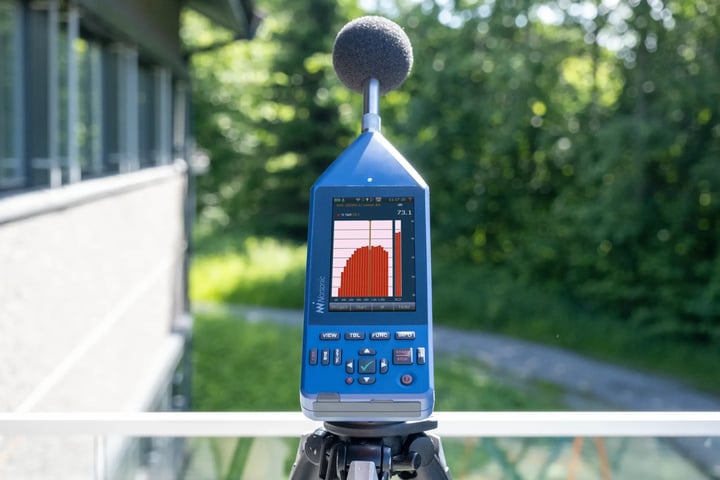
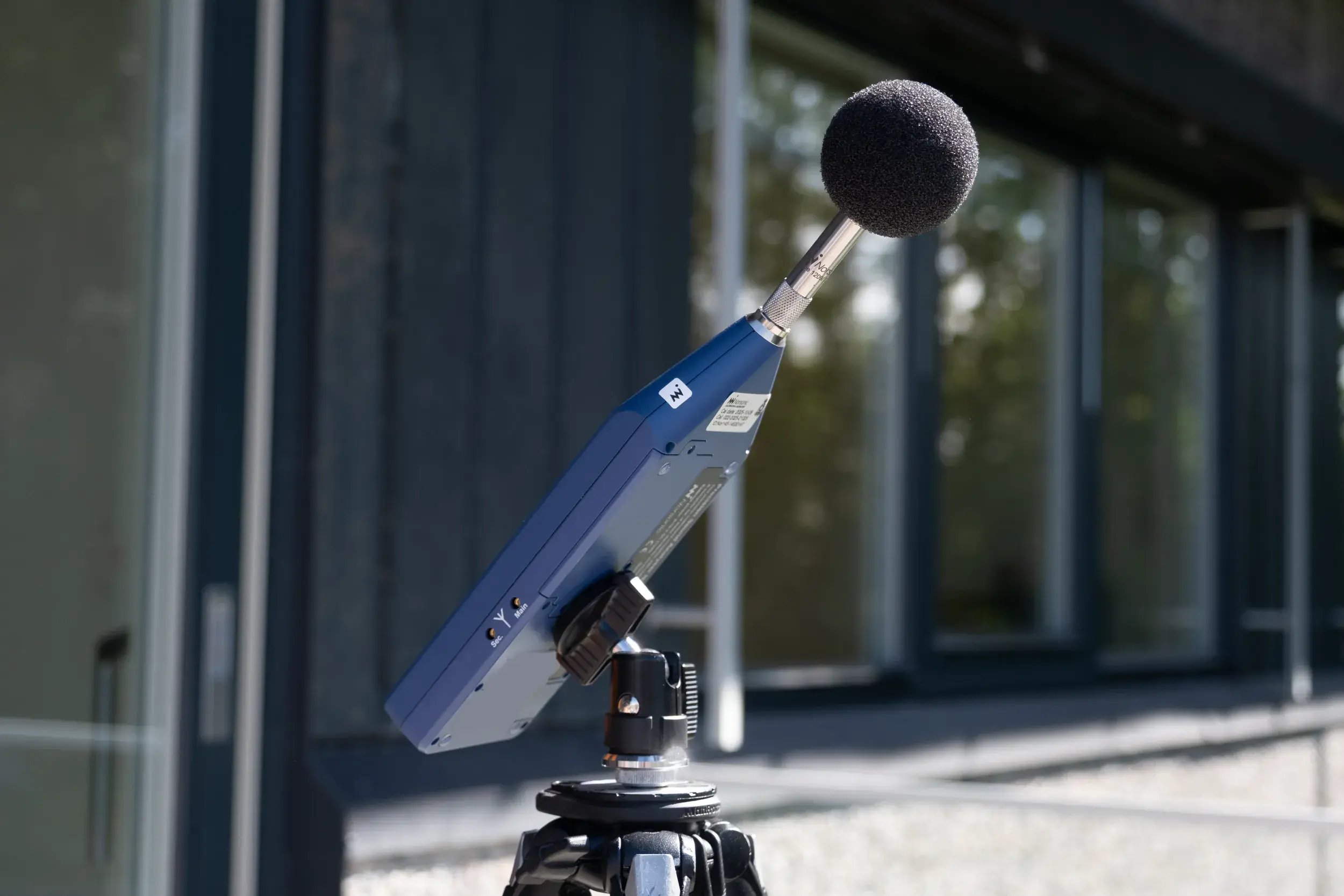
Façade sound insulation measurements evaluate the relationship between the sound level outside the building and the sound level measured inside the receiving room.
Depending on the measurement objective and site conditions, the external sound field may be generated by natural environmental noise sources, such as road traffic, or by an artificial sound source positioned outside the building.
Measurements are performed in frequency bands to evaluate how the façade attenuates sound across the audible frequency range.
Why is reverberation time relevant in façade sound insulation measurements?
Reverberation time directly affects the sound pressure level measured inside the receiving room.
For this reason, façade sound insulation results are normalized using the reverberation time of the receiving space. Without this correction, measurement results would depend on the acoustic condition of the room rather than on the insulating performance of the façade itself.
Why is background noise relevant in façade sound insulation measurements?
Background noise directly affects the sound pressure levels measured during façade sound insulation tests.
For this reason, background noise is assessed as part of the measurement procedure. Without considering background noise, the measured indoor levels may not accurately represent the sound transmitted through the façade.
Why are measurements performed by frequency band?
The sound insulation performance of façades varies significantly with frequency.
Windows, walls, ventilation openings, and other façade elements may provide different levels of insulation across the frequency range. Low-frequency noise, in particular, often presents greater challenges than mid- or high-frequency noise.
In addition, some façade elements—especially glazing systems—may exhibit reduced insulation performance at specific frequencies. These frequency-dependent weaknesses can significantly influence the overall acoustic performance of the façade and may not be visible in broadband measurements.
Measuring in octave or third-octave bands allows these effects to be identified and characterized, providing a much more detailed understanding of façade performance than a single overall sound level.
How is façade sound insulation calculated?
Façade sound insulation measurements are first evaluated by frequency band.
The indoor sound pressure levels are corrected for background noise when necessary and normalized using the reverberation time of the receiving room. The resulting data are then compared with the corresponding outdoor sound levels.
This produces a frequency-dependent façade sound insulation curve describing how effectively the building envelope attenuates external noise.
For practical use and comparison purposes, the measured spectrum is typically converted into a single-number rating according to the relevant standards.
Typical applications of façade sound insulation measurements
Façade sound insulation measurements are commonly performed in:
-
residential buildings,
-
hotels,
-
schools and universities,
-
healthcare facilities,
-
office buildings,
-
buildings located near roads, railways, airports, or industrial areas.
These measurements help verify compliance with regulations and assess the acoustic protection provided by the building envelope.
Façade Sound Insulation Measurements with Nor145 and Nor850
Nor145 and Nor850 provide tools for measuring, analyzing, and reporting façade sound insulation performance
The workflow includes sound pressure level measurements, reverberation time measurements, background noise assessment, frequency analysis, and reporting according to relevant standards.
Integrating all measurement parameters within a single platform simplifies the evaluation process and improves documentation consistency.
Applicable Standards
Façade sound insulation measurements in buildings are commonly performed in accordance with ISO 16283-3.
The resulting single-number ratings are typically determined according to ISO 717-1.
Together, these standards define the measurement procedures, evaluation methods, and reporting requirements used to assess façade sound insulation performance.
Benefits of Façade Sound Insulation Measurements
Key benefits include:
-
objective evaluation of façade acoustic performance,
-
verification of compliance with building regulations,
-
assessment of indoor protection against outdoor noise,
-
comparison of alternative façade constructions,
-
support for building design and acoustic optimization.
Limitations and Practical Considerations
Façade sound insulation measurements evaluate the acoustic performance of the façade as installed in the building. As a result, the measured value reflects the combined contribution of all façade elements, including walls, windows, doors, ventilation openings, and installation details.
For this reason, the overall result is often governed by the weakest transmission path rather than by the best-performing elements. A high-performance wall, for example, may provide limited benefit if the sound insulation of adjacent windows or other façade components is significantly lower.
/Nor286-Origami/Nor286-origami-light-blue-800x600px.webp?width=450&height=275&name=Nor286-origami-light-blue-800x600px.webp)
/Nor850%20Software%20transparent%20webp%20(664x664px)/Nor850-RA-ISO3382.webp?width=450&height=275&name=Nor850-RA-ISO3382.webp)
/Noise%20sources%20transparent%20webp%20(664x664px)/Nor277-Tapping-machine-transparent-(664x664px).webp?width=450&height=275&name=Nor277-Tapping-machine-transparent-(664x664px).webp)


