 NorCloud login


/Nor286-Origami/Nor286-Origami%202.webp?width=720&name=Nor286-Origami%202.webp)
What is the impulsive method?
The impulsive method is one of the procedures described in the ISO 3382 series of standards for measuring reverberation time (RT) in rooms.
This method is based on exciting the room with a very short acoustic signal that introduces a large amount of sound energy in an almost instantaneous time interval. Unlike the interrupted noise method, the impulsive method does not require reaching a steady-state sound field before the measurement.
After the impulse is generated, the decay of the sound in the room is analysed directly.
Principle of operation of the impulsive method
When an acoustic impulse is generated in a room, the sound energy propagates from the source, reflects from the room surfaces, and progressively decays due to acoustic absorption by the air, the room surfaces, and the elements present in the space.
The sound level meter records the impulse response of the room, meaning the temporal evolution of the sound pressure level following the impulse. From this recording, the decay curve is obtained and used to calculate the reverberation time by frequency bands.
The analysis principle is the same as in other methods: the slope of the sound decay is analysed once the excitation has ceased. In this case, however, the excitation consists of a single, brief acoustic event.
Impulsive excitation sources
Impulsive excitation can be generated using different sources, provided that the impulse contains sufficient energy and spectral content within the frequency range of interest. Commonly used sources include:
-
balloon burst
-
starter pistol
-
standardized impulsive sources specifically designed for acoustic measurements, such as the Origami Impulse Source Nor286
Using standardized impulsive sources improves the repeatability of the measurements and ensures adequate energy distribution across the spectrum, particularly when frequency-band analysis is required.
/Nor286-Origami/Nor286-Origami%203.webp?width=7008&height=4672&name=Nor286-Origami%203.webp)
Recording the decay and time analysis
After the impulse is emitted, the sound level meter records the temporal response of the room. This recording includes both early reflections and the progressive decay of the sound field.
The resulting decay curve is analysed to calculate common reverberation parameters such as EDT, T20, and T30, both globally and by frequency band.
As with other measurement methods, the final portion of the decay may be limited by the background noise level present in the room, which determines the available dynamic range for the analysis.
Sound analysers that incorporate dedicated impulse response measurement functions allow this process to be performed automatically and reproducibly.
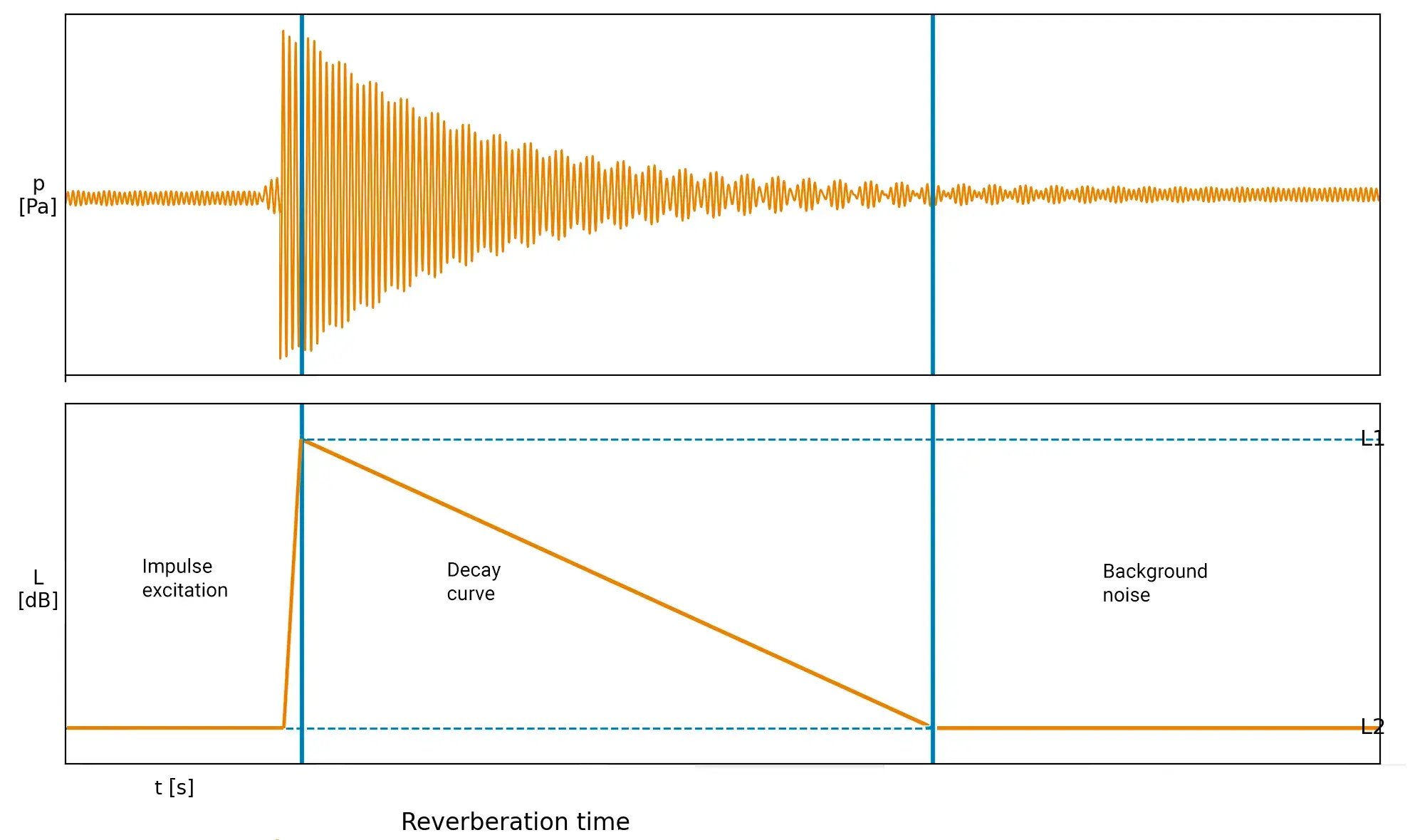
Graphic RT impulse source method
Advantages of the impulsive method
The impulsive method stands out primarily for its speed and simplicity of implementation. Its main advantages include:
-
no need to reach a steady-state sound field before the measurement
-
very short measurement times
-
ease of use when installation time is limited
-
absence of continuous noise sources during the measurement
These characteristics make the impulsive method particularly suitable for rapid measurements and preliminary acoustic evaluations.
Limitations and practical considerations
The reliability of the impulsive method largely depends on the impulse containing sufficient energy across the entire frequency range of interest. In particular, low frequencies can be difficult to excite adequately using simple impulsive sources such as balloons or starter pistols.
Furthermore, the method is more sensitive to background noise than other procedures, especially in large rooms or in environments with high ambient noise levels. In these situations, the decay may become masked before a sufficient dynamic range is reached for accurate analysis.
For this reason, in large rooms or complex acoustic conditions, other methods such as the interrupted noise method or the swept sine method may provide more robust results.
Typical applications of the impulsive method
The impulsive method is commonly used in:
-
small and medium-sized rooms
-
field measurements
-
rapid evaluations of acoustic behaviour
-
situations where it is not practical to use a larger external sound source
Whenever an appropriate impulsive source is available and the background noise level is sufficiently low, the method allows reliable estimation of EDT, T20, and T30.
Relationship with other reverberation time measurement methods
The impulsive method shares the same conceptual basis as the interrupted noise method and the swept sine method: analysing the decay of sound after the excitation has ceased.
The main difference lies in how the excitation signal is generated and in the stability of the sound field before the decay begins. The choice of the most appropriate method depends on the type of room, the background noise conditions, and the requirements of the measurement.
/Nor850%20Software%20transparent%20webp%20(664x664px)/Nor850-RA-ISO3382.webp?width=450&height=275&name=Nor850-RA-ISO3382.webp)
/Noise%20sources%20transparent%20webp%20(664x664px)/Nor277-Tapping-machine-transparent-(664x664px).webp?width=450&height=275&name=Nor277-Tapping-machine-transparent-(664x664px).webp)


