 NorCloud login


.webp?width=720&name=Image-105-(2736x1824px).webp)
What is the interrupted noise method?
The interrupted noise method is one of the classical procedures described in the ISO 3382 series of standards for measuring reverberation time in rooms.
This method is based on exciting the room with a continuous sound source until a steady-state sound field is reached and then analysing the sound decay when the source is abruptly stopped.
It is widely used in both room acoustics and building acoustics due to its robustness, reliability, and the stability of the decay curves it provides under a wide range of measurement conditions.
Principle of operation
During the measurement, the room is excited using broadband noise, typically pink noise, reproduced continuously through an appropriate sound source until the measured sound pressure level stabilizes over time.
This steady state indicates that the acoustic energy introduced into the room is balanced by the energy leaving the system through the absorption mechanisms present in the enclosure.
At this point, the sound field can be considered stable and representative of the overall acoustic behaviour of the room.
Once this steady state is reached, the sound source is abruptly interrupted and stops introducing energy into the room. From that moment on, the sound level meter records only the decay of the acoustic energy stored in the room.
The slope of this decay is analysed to determine the reverberation time, both globally and by frequency bands.
Sound excitation and diffuse sound field
For the interrupted noise method to provide representative results, it is essential that the excitation produces a sound field that is as diffuse as possible within the room.
For this reason, the room is typically excited using pink noise emitted by a sound source designed to radiate sound uniformly in all directions, such as a dodecahedral loudspeaker Nor283.
The objective of this excitation is to ensure that the acoustic energy is distributed as uniformly as possible throughout the space so that reflections contribute evenly to the sound field.
In this way, the decay recorded after the source is interrupted reflects the global acoustic behaviour of the room rather than the effect of particular directions or positions.
.webp?width=2736&height=1824&name=Image-105-(2736x1824px).webp)
Recording the sound decay
Once the excitation signal is interrupted, the sound level meter records the decay of the sound pressure level as a function of time.
This decay reflects how sound energy progressively dissipates due to absorption by the surfaces of the enclosure, the air, and the elements present in the room.
The initial part of the decay is typically the most reliable, while the final portion may be limited by the background noise level present in the room.
This background noise determines the available dynamic range for the analysis and therefore influences which parameters can be calculated with sufficient accuracy.
From the recorded decay, common reverberation parameters such as EDT (Early Decay Time), T20 and T30 can be obtained, both globally and by frequency band.
Sound analysers that incorporate dedicated reverberation time measurement modules allow the excitation signal to be automatically started and interrupted, the decay to be recorded, and these parameters to be calculated in a reproducible and automated way.
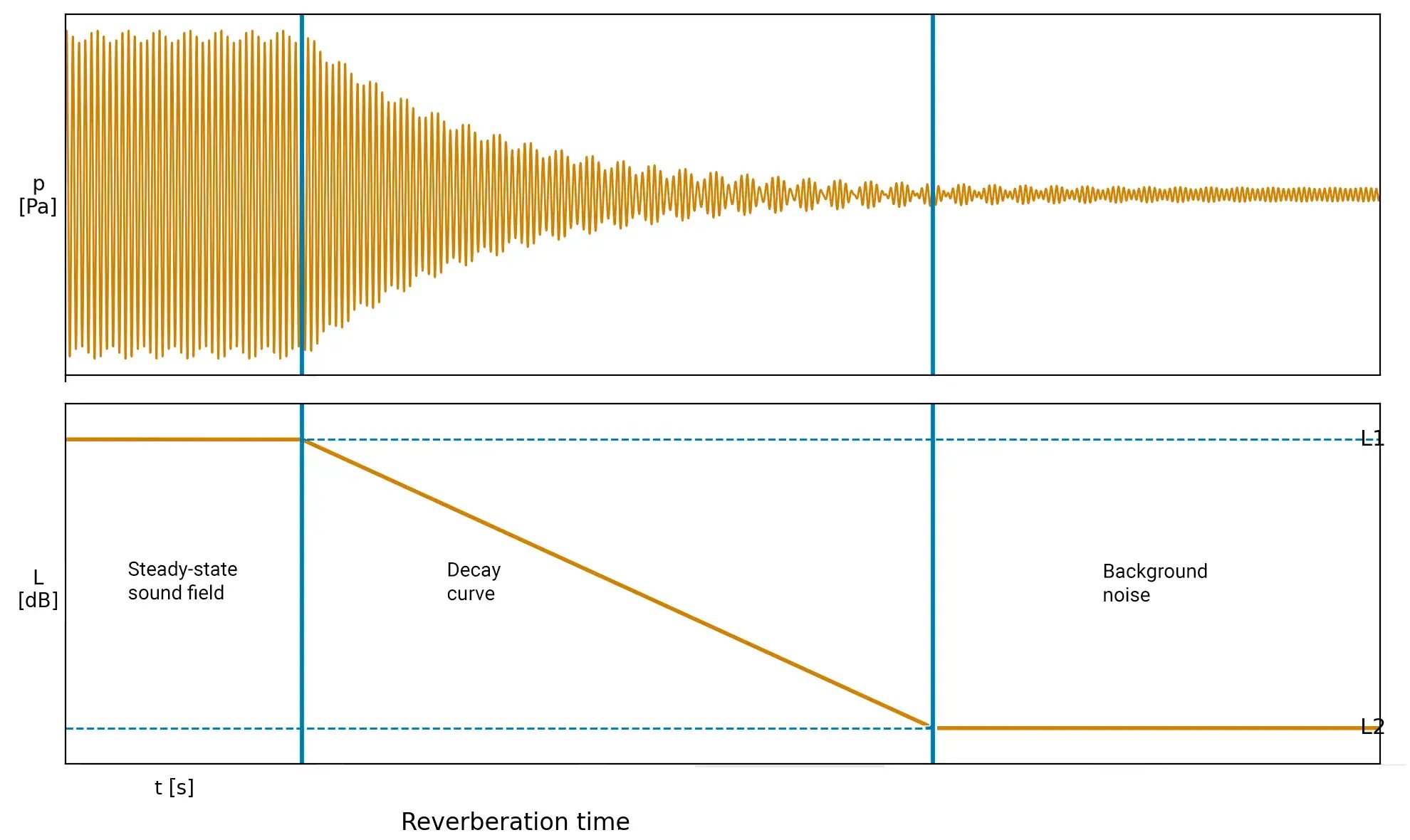
Graphic RT interrupted source method
Frequency band analysis
One of the main advantages of the interrupted noise method is its suitability for analysis by frequency bands, both in octave bands and one-third octave bands.
For this type of measurement, sound sources capable of generating band-limited noise can be used, allowing specific frequency bands to be excited individually.
This can be particularly useful when high accuracy is required in the spectral analysis of reverberation time.
Frequency-band analysis makes it possible to evaluate how the acoustic behaviour of the room varies across the spectrum, which is essential information for acoustic design and the evaluation of acoustic comfort.
Applications of the interrupted noise method
The interrupted noise method is particularly suitable for:
-
medium and large rooms
-
enclosures with moderate background noise levels
-
measurements requiring high accuracy by frequency band
-
studies where stable and well-averaged decay curves are required
Due to these characteristics, this method is widely used in laboratory measurements and in tests where high repeatability of results is required.
Practical advantages and limitations
Among the main advantages of the interrupted noise method are:
-
stable and well-averaged decay curves
-
good robustness against small variations in the sound field
-
excellent behaviour for frequency-band analysis
As practical limitations, the method requires:
-
a sound source capable of generating sufficient acoustic level
-
longer measurement times than faster excitation methods
-
measurement conditions that allow a steady state to be reached before the source is interrupted
In some situations, such as small rooms or quick field measurements, other methods—such as the impulsive reverberation measurement method or the swept sine method—may be more practical.
Relationship with other reverberation time measurement methods
The interrupted noise method shares the same conceptual basis as other reverberation time measurement methods: analysing the decay of sound after the excitation stops.
However, it differs from the impulsive method and the swept sine method in the way the excitation signal is generated and in the stability of the sound field prior to the decay.
The choice of the most appropriate method depends on the type of room, the background noise conditions, and the requirements of the measurement.
/Nor286-Origami/Nor286-origami-light-blue-800x600px.webp?width=450&height=275&name=Nor286-origami-light-blue-800x600px.webp)
/Nor850%20Software%20transparent%20webp%20(664x664px)/Nor850-RA-ISO3382.webp?width=450&height=275&name=Nor850-RA-ISO3382.webp)


