 NorCloud login


/Nor286-Origami/Nor286-Origami%203.webp?width=720&name=Nor286-Origami%203.webp)
What is reverberation time?
Reverberation time is defined as the time required for the sound level in a room to decrease by 60 dB after the sound source has ceased.
It is one of the most important parameters both in building acoustics, due to the persistence of sound in the receiving room, and in room acoustics, since it directly influences speech intelligibility, acoustic comfort, and perceived sound quality.
Rooms with little acoustic absorption typically present longer reverberation times than those with a higher proportion of absorbing materials. The level of acoustic absorption in a room depends on the materials forming its surfaces or on the materials covering those surfaces.
A tiled and empty room usually exhibits very low acoustic absorption. In contrast, a room with wooden walls and flooring, covered with carpets, curtains, and sofas, will present significantly higher acoustic absorption.
What is the ideal reverberation time?
There is no single ideal reverberation time. Appropriate reverberation times depend on the intended use of each room.
For example, a voice recording studio typically requires a low reverberation time, around 0.2–0.3 seconds. In classrooms, recommended values usually fall between 0.5 and 0.7 seconds. Opera houses, on the other hand, typically require higher values, around 2 seconds.
If a lecture were delivered in an opera house, speech intelligibility would be very poor because the large number of sound reflections would make the message difficult to understand. Conversely, if an opera were performed in a vocal recording studio, many of the acoustic characteristics that define this type of music would be lost.
Can reverberation time be estimated theoretically?
For typical rooms with moderate absorption, reverberation time can be approximated using the Sabine formula:
T = 0.16 · V / A
where:
T is the reverberation time in seconds
V is the room volume in cubic meters
A is the equivalent absorption area
This model shows that reverberation time does not depend solely on the acoustic absorption of the room but also on its volume. Two rooms with similar total surface areas but different volumes will have different reverberation times. Larger volumes generally result in longer reverberation times.
Each room, with its specific dimensions and geometry, will produce different results. For this reason, copying acoustic solutions applied in another room does not guarantee achieving the same reverberation time.
In rooms with extremely high absorption, such as anechoic chambers, sound decays too rapidly for the assumptions of the Sabine model to hold, and other approaches must be considered.
How is reverberation time measured in practice?
In real measurements, reverberation time is obtained by analysing the decay of sound after the room has been excited. This requires:
-
an appropriate excitation method capable of filling the room with sound according to its volume and the frequency range of interest,
-
instrumentation capable of capturing and analysing the decay reliably.
In practice, three main excitation methods are used:
All three methods share the same basic principle: a sound excitation is generated at a sufficient level and, once the excitation stops, the time required for the sound pressure level in the room to decay is calculated. The difference between the methods lies in how the excitation signal is generated and in the procedure used to transform that signal into the final result.
What is the decay curve?
The decay curve represents the sound pressure level as a function of time and describes the reduction of acoustic energy in a room after the excitation has ceased.
In real rooms, the final part of the decay curve is often limited by the existing background noise level. This background noise determines the available dynamic range and influences the calculation of parameters such as EDT, T20, or T30.
Reverberation time parameters: EDT, T20, and T30
Although reverberation time is formally defined as a 60 dB decay, in practice it is rarely possible to measure this full range because of background noise. For this reason, several related parameters are used and the result is extrapolated to 60 dB.
The most commonly used parameters are:
EDT (Early Decay Time), calculated from the first 10 dB of decay,
T20, based on a 20 dB decay, typically between −5 dB and −25 dB,
T30, based on a 30 dB decay, typically between −5 dB and −35 dB.
If the decay is linear, these parameters should provide similar results.
When is EDT particularly important?
EDT is particularly relevant in room acoustics because it reflects how the room sounds immediately after the sound stops. This early behaviour has a significant influence on human perception.
EDT is especially important for evaluating speech intelligibility, perceived clarity, and the acoustic “liveliness” of a space. It is therefore a key parameter in classrooms, offices, theatres, and concert halls. In many cases, EDT correlates better with subjective perception than T20 or T30, particularly in rooms where early reflections dominate the listening experience.
Reverberation time measurement methods in practice
Depending on the type of room, the existing background noise level, and the practical conditions of the measurement, one method may be more suitable than another.
The interrupted noise method is widely used due to its robustness and the stability of the decay curves it provides.
The impulsive method stands out for its speed and simplicity, particularly in small rooms and quick measurements.
The use of swept sine signals is particularly useful when background noise limits traditional measurements or when low-frequency behaviour is critical.
Each method offers practical advantages depending on the application context.
Implementation of these methods in modern measurement systems
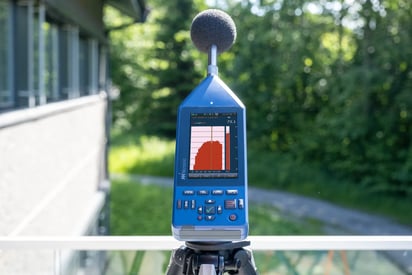
Modern building and room acoustics measurement systems allow the three excitation methods to be integrated within a single measurement platform. This makes it possible to measure reverberation parameters such as EDT, T20, and T30 using impulsive excitation, interrupted noise, or swept sine signals generated by software.
This flexibility allows the most appropriate method to be selected depending on the type of room, the measurement requirements, and practical limitations, while maintaining a consistent workflow.
/Nor286-Origami/Nor286-origami-light-blue-800x600px.webp?width=450&height=275&name=Nor286-origami-light-blue-800x600px.webp)
/Nor850%20Software%20transparent%20webp%20(664x664px)/Nor850-RA-ISO3382.webp?width=450&height=275&name=Nor850-RA-ISO3382.webp)


