NorCloud login


How does the floor contribute to sound radiation?
A dodecahedron sound source has individual loudspeaker units arranged around a polyhedral enclosure to approximate omnidirectional radiation. A hemi-dodecahedron uses half of that geometry and has a flat base that allows it to sit directly on the floor.
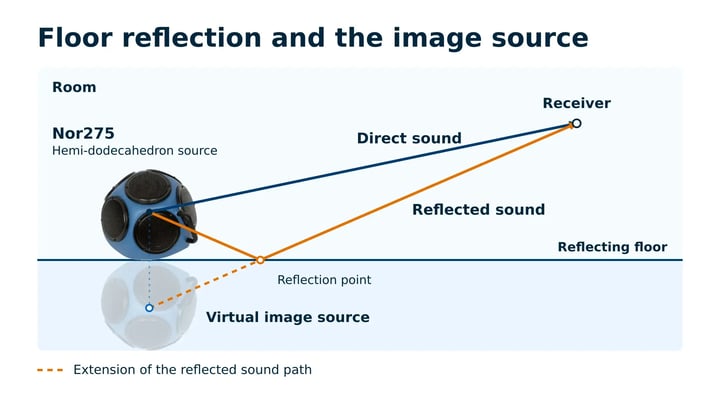
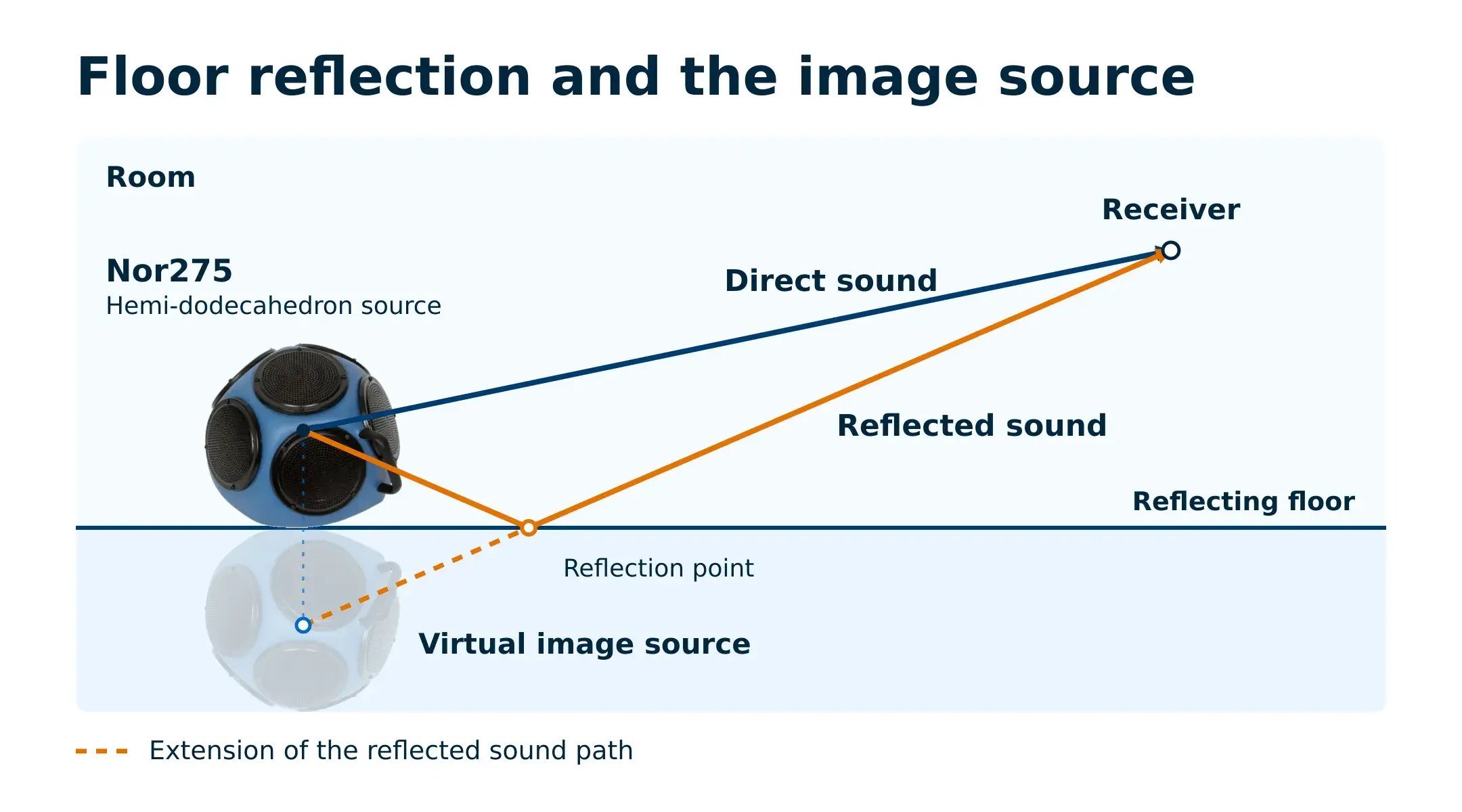
The image source method helps explain this arrangement. If the floor is flat and ideally rigid, the reflected sound can be modelled as coming from a mirror image of the source below the floor. The direct and reflected sound combine in the hemisphere above the floor.
[Figure: side view of the Nor275 showing the direct sound path, the floor reflection and the image source.]
 The Nor275 features six equally spaced loudspeaker elements, designed to provide a near-uniform sound radiation pattern across the hemisphere above the floor.
When is a floor-mounted source used to measure airborne sound insulation?
Annex A of ISO 16283‑1 describes the use of a hemispherical polyhedral sound source, such as the Nor275, placed directly on the floor to achieve approximately uniform radiation in airborne sound insulation tests.
For tests between storeys, the source position depends on which room is used as the source room. When the upper room is used, the standard requires the source to be raised sufficiently to prevent the direct sound from significantly exciting the floor structure. It also recommends placing resilient material beneath the stand to limit vibration transmission. In this case, a dodecahedron loudspeaker such as the Nor283 can be mounted on a tripod.
Read more about airborne sound insulation measurements
How is the excitation adjusted during the test?
When assessing a wall or floor with high sound insulation, sufficient sound power helps ensure that the transmitted signal can be measured above the background noise. Equalising the broadband noise allows the spectrum in the source room to be adjusted and reduces level differences between adjacent one-third-octave bands. When the Nor275 is used with the Nor282 power amplifier, the equalisation preset for the Nor275 provides a starting point for this adjustment.
For broadband excitation, the Nor275 can be used with either the Nor280 or the Nor282 power amplifier. With either amplifier, the Nor275 delivers a sound power level of 120 dB over the 50 Hz to 5 kHz frequency range. The Nor282 also allows the excitation spectrum to be adjusted or noise to be generated in a selected octave or one-third-octave band. This is useful when more excitation is needed in a particular band to measure the transmitted sound above the background noise.
Can a hemi-dodecahedron sound source be used to measure reverberation time?
A hemi-dodecahedron sound source such as the Nor275 is placed directly on a reflecting floor and uses the reflection to excite the room. In in situ airborne sound insulation tests between rooms, as described in ISO 16283‑1, this setup can be used to measure the reverberation time of the receiving room and account for its sound absorption in the sound insulation calculation.
If the aim is to characterise reverberation in the room itself, for example when assessing the acoustic treatment of a classroom, ISO 3382‑2 applies. It covers reverberation time measurements in ordinary rooms. The hemi-dodecahedron source can be used with interrupted noise or a sine sweep. If the procedure requires several source positions, the source is moved from one position to the next and placed directly on the floor at each one.
In a concert hall, by contrast, a dodecahedron loudspeaker such as the Nor283 can be mounted on a tripod and placed at different points on the stage at a height representative of the performers. Its directivity meets the criteria of ISO 3382‑1 for measuring room acoustic parameters in performance spaces. ISO 3382‑2 applies the same source directivity criteria when the precision method is used.
Read more about reverberation time measurement methods
Choosing a sound source for the measurement
For a hemi-dodecahedron sound source, the reflecting floor forms part of the measurement setup. The choice of source depends on where the sound needs to be generated, how it should radiate into the room and the requirements of the measurement procedure.
Learn more about the Nor275 hemi-dodecahedron sound source
Learn more about the Nor283 dodecahedron sound source